Introduction and update
Having enjoyed writing close to 40,000 words across three months on the road in Latin America, I assumed maintaining the practice when I returned to London would be simple. However, finding the state of mind to create something worth sharing, has proved far more challenging than I anticipated, especially for the first three months, when I largely sat, liminal, in my living room chair.
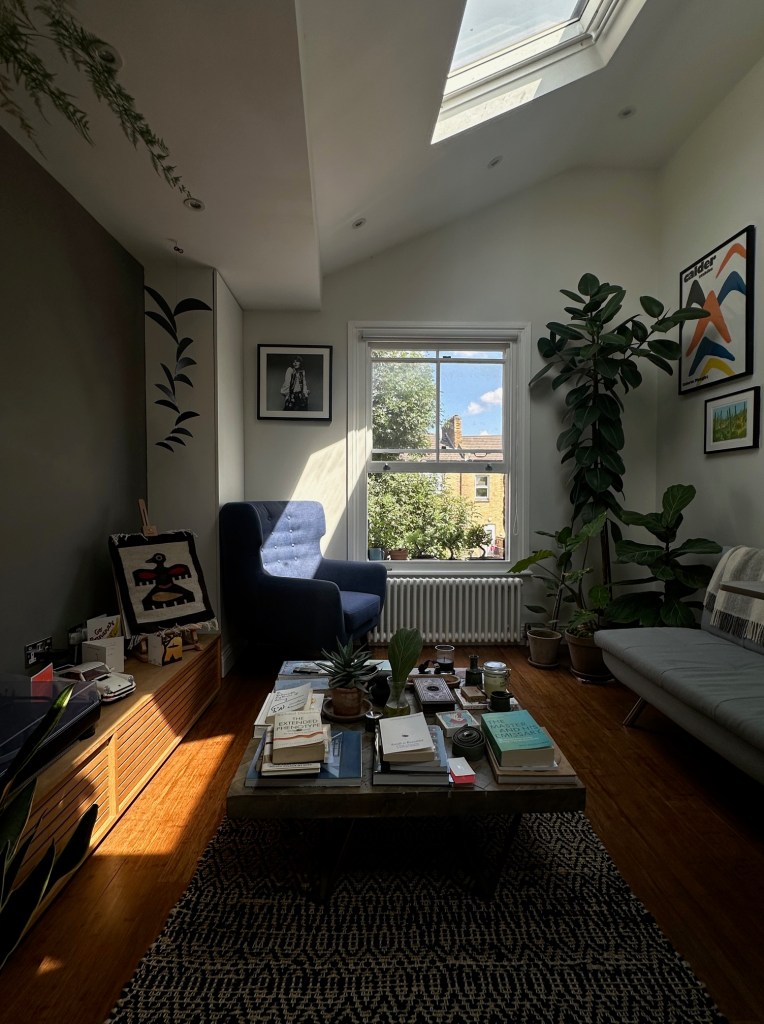
Most of what was written during this time belongs in a personal journal, but below is an excerpt from a longer piece I wrote as part of a course I enrolled in at Central St Martin’s.
As we approach the end of the year I will consider a resolution of sorts – to set aside the time and attempt to find the space that may allow for something creative to emerge.
Here and now
Summer 2024; Devon, England
Patagonia is ‘now’ a memory. The places and people, and the versions of myself that I found there are traces – traces of memories that layer into the palimpsest. And sat atop is the version that exists in the here and now.
Except, that that is an illusion, isn’t it? The version of me writing this is just like the version of you reading it – no longer there.
We are deeply aware of and driven by our pasts – pasts we know once existed, because traces remain. But we are stuck somewhere between those past selves and the futures we wish for. We are held, tragically, in time.
As for the ‘here’, I am standing at the window in the middle bedroom, on the first floor of a 16th-century Devonian farmhouse; a prominent dwelling within the small coastal village of Strete, which my parents call home.
Several hundred yards inland and crowning a granite outcrop that rises between sandstone valleys, the village is afforded a distinctive perspective of the Southwest Coast. To the East, past the omnipresent rust-red hills, stripped bare by agriculture across millennia and truncated by sharp, verdant valleys; beyond the stubborn stacks of igneous rock finally giving up their antediluvian fight to the Channel, is the estuary of the River Dart; water that began its journey to the North, on Dartmoor. And to the West, beyond the spit of the Slapton Sands – to the edge of my perspective – sat upon distant cliffs, Start Point lighthouse; a pervading reminder of the cost to lives reliant on this stretch of coastline.
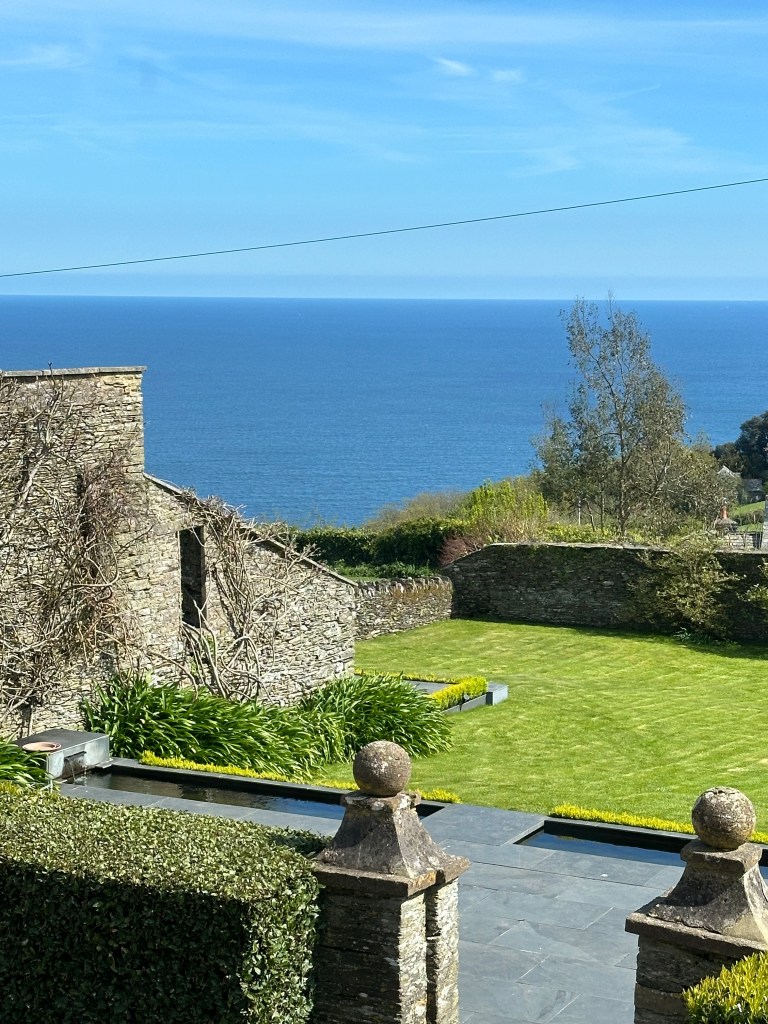
It’s a big view; a big sea and big skies that feel more like Hopper’s New England than this ancient corner of the West Country. And on this archetypal late August evening, it would struggle to be grander, or more majestic, in presenting its many stories of time.
But I’m not interested in what’s out there, I’ve been struck by something in here – in this room, inside these thick limestone walls that for over four centuries have safely housed families and their stories. I grew up in England – mostly in old houses – so it was not until I’d spent time in the new world that I started to understand the privilege it has brought me – to be the custodian of so much time condensed into one place.
The summer bank holiday of village fetes, evening walks to the beach and swims at dusk, of games of Pooh Sticks in the streams of the valley floors, has come to a close, and I have stayed behind, alone. I’m not used to being left; I tend to do most of the leaving in my life, but on this rare occasion, I must bear the emotional weight of the traces that remain.
The room belongs to a little boy. A little boy of three years old, called Louis; my nephew, who, for the past week and until no more than 10 minutes ago, was playing here. The sound of his voice is fresh in my ears, the pure joie de vivre and raw emotional energy of this tender human so palpable in their sudden absence.
Aware that I haven’t moved in some time, I walk away from the window, across the room to a small bed pushed up against the wall – a bed that my father and I assembled only months prior – draped in a duvet that was once mine. I pull back the covers; a tiny pair of pyjamas are neatly folded on the sheet. I climb in. Puff the Magic Dragon soars above me as he once did when I was three; various animals from the Hundred Acre Wood (made by my mother out of old shirts and towelling robes) observe me for the first time in over three decades from the end of their new bed.
Laid out to my right is the vast majority of a week’s work; a little boy’s attempt at ordering chaos. Traffic jams of imagined necessity line the room: Matchbox cars that belonged to my uncle, as they belonged to me, and now to Louis, form the majority of this miniature civic scene. A tractor is in the van; ahead of several Porsche 911s, a muscle car and a Royal Mail lorry; a NASA transporter for the Saturn V rocket has been improvised to carry a red Sopwith Camel, and a 1972 Maserati Bora is parked just ahead of three Duplo chickens, towering over an upturned cement mixer. A colossal Tonka crane idles menacingly to one side.
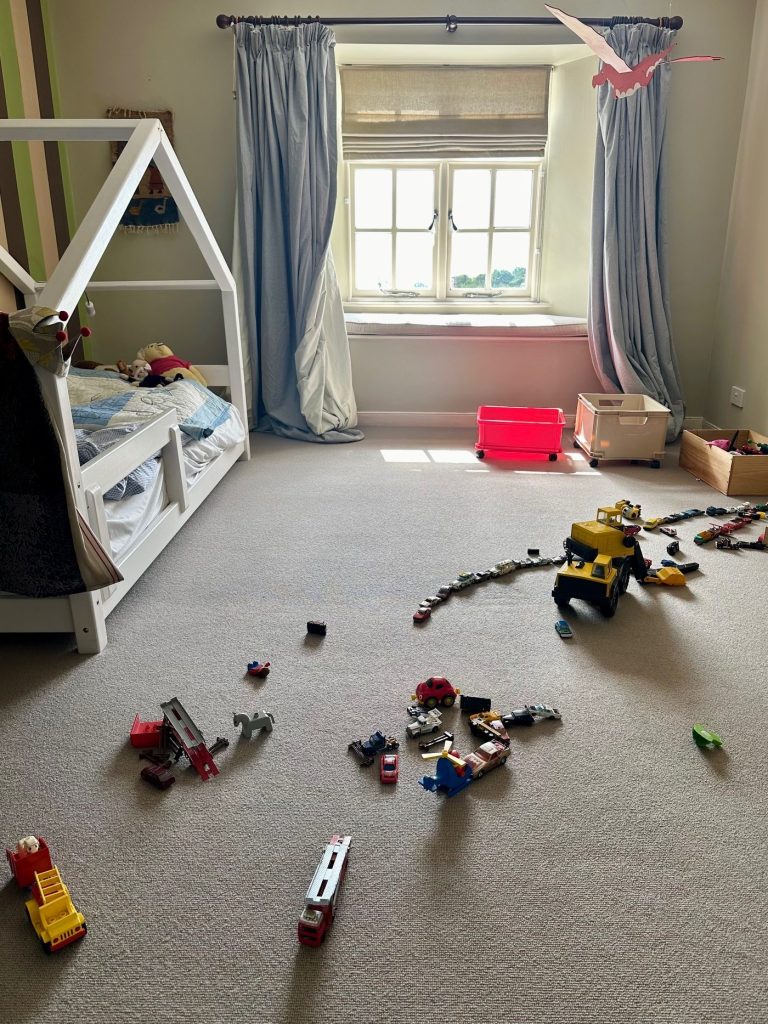
Several more tracks of totems, and of a child’s stories incomplete, are spread over the room; extrapolated across generations. A beautiful expression of the emerging human instinct to fight entropy.
Allowing ourselves to exist in a child’s space and time can soften us; encourage us closer to the most vulnerable version of ourselves – our child – when, naive to the order of time, we could not be held in it.
As adults, we can think of the present as something between the past and the future. A child is not held to this liminality; the present is all that is – it is everything.
Has the abrupt absence of this child, in this room, enabled me to form lost connections with myself? Ones, which have allowed me to reach out of time for a moment – to the here and now.

 Another Door In the Wall