9th – 23rd of March, 2024
Antigua
It feels good to be on the move again. My brain is eager for tasks and order. A scattered mind like mine requires routine or I can quickly spin out of control (as you may have noticed from my previous post).
I’ve come to Guatemala for the coffee (more on that later), so basing myself in Antigua–a UNESCO World Heritage site–is the ideal way to take in the region. An old colonial capital, it reminds me of Oaxaca in Mexico, but with an added seismic threat that must surely have an effect on cultural development. There is, for example, great reverence paid towards a fairly mundane-looking arch from the 17th century, which at first, I can’t work out, until I realise that this a fairly impressive feat in a place that, on average, records over 30 earthquakes per year.
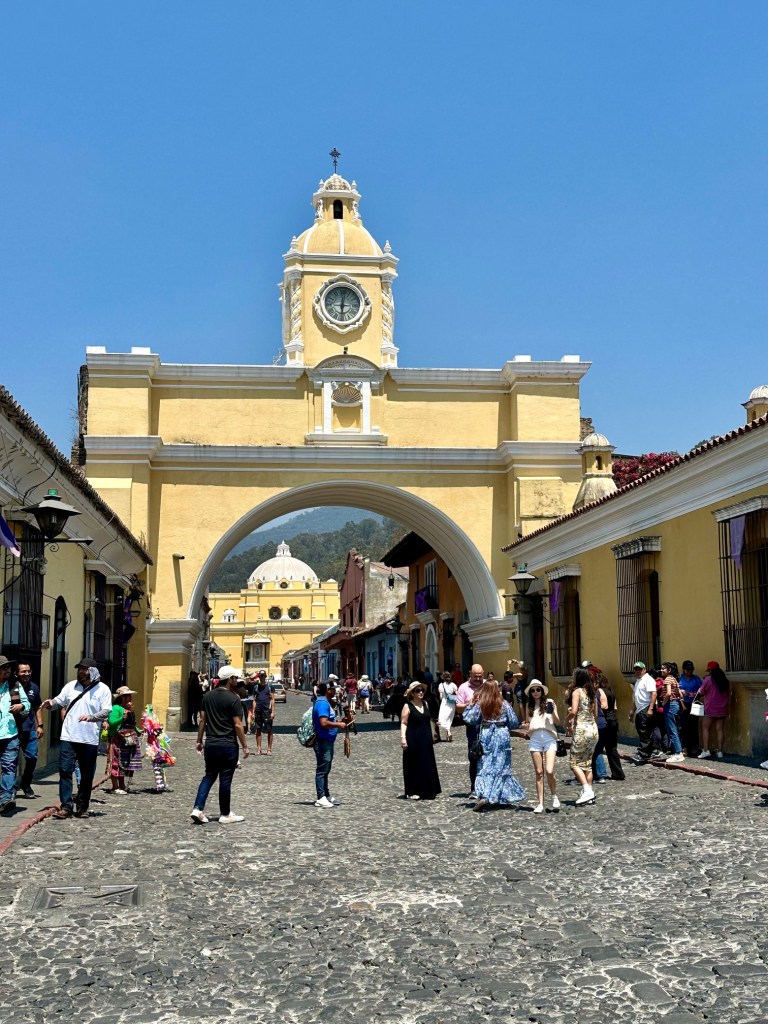
Interesting, because it’s still standing.
We all have an optimum operating temperature. I am a cold-weather person–I run hot, and my nervous system naturally relaxes in colder weather. I’m one of those weirdos who looks forward to autumn–to getting the jumpers and coats out. My ideal climate is South West England in October / November. To be here, 1,500m above sea level, where I can finally wear trousers and shoes again, feels wonderfully calming after bumming about in my smalls in the intense heat of Costa Rica. Even if it does mean thinner air again.
Today is International Women’s Day. So, I phone my sister and then my Mum. One of my favourite stories of my mother is from her early 20s when she lived in Iraq–pre-Sadam–nannying for the Director of the British Archaeological Survey. Unsurprisingly, women were not allowed on the upper deck of the bus. My mother, wearing jeans, without a head covering, and armed squarely with her ‘fuck authority’ attitude that I have proudly inherited, decided she would sit up there anyway. ‘Why’–she used to espouse passionately to my sister and me, whilst driving her red Mk2 Golf GTI at the kind of pace that kept me just at the edge of my booster cushion–‘should these fat old men get to tell me what to do?’ I fact-check this with her over the phone and she reminds me of the hours she spent in immigration with her V1 Sony Walkman–they’d never seen tapes on a civvy and were convinced she was a spy.
The other key woman in my life–my 91-year-old grandmother, Nonnie (or the Constant Gardner, as she is affectionately known)–is not available over the phone, but we do email. Her vicious wit, verging at times on misanthropy, is as sharp as ever, and she is still capable of making me howl with laughter. When I told her about this trip, she wasn’t hugely enthusiastic (is a polite way of putting it), but I am looking forward to talking her through the various gardens, trees, and plants I’ve encountered. Even if they’re a bit foreign.
She’s had a tough life, my grandma, and I think about her a lot. She lived in London during the Blitz and tells stories of falling Nazi rockets “You could hear their engines getting closer, then they’d cut out, and you’d sit there hoping it wasn’t directly above you”. Her matter of fact–almost fireside–tone is only shocking to me now. As a child, I lapped these stories up like it was Jacka-fuckin-nory.
My mind’s gone to some strange places on my travels, not least some of the dubious (probably Victorian) children’s literature that (along with stories of Nazi bombs) Nonnie used to read to Chloe and me. Briar Rabbit (use tactical lies to get what you want); The Water Babies (more pious nonsense); and The Pied Piper of Hamelin. The Pied Piper of fucking Hamelin! What sort of fucked up childhood imagery is that? I mean, I get the plague references, but really! Telling kids that some bloke with a flute was going to come along and steal us away in a trance? From you? The moral point is in the wrong place! It’s essentially dictating that should you–you know, the adults in charge–not pay the protection money, then a drooling pervert with a magic pipe is going to entice me– (for once) innocent little child–away. I’d been warned that paedophiles might try and entice me with ice cream, or sweets, but surely the pipe rendered me powerless? I knew this was highly probably horseshit, and therefore unlikely to happen, but I couldn’t be convinced that it might not have happened at some point in the past. And it gave me a sense of helplessness. Whatever these adults tell me, I thought after hearing that story, if they don’t do as they’re told, then I’m far more fucked than if it’s just me not doing as I’m told. I’m on my own here. No wonder I have abandonment issues. I’ve just realised Hamleys–the largest toy store in London–isn’t a massive leap. Were they in on this, too?

Let’s all keep the generational trauma firmly in the system.
All of this nonsense is rattling around my brain as I sit on the roof of the Antigua Brewing Company, drinking my first proper beer in weeks. (They have an appetite for a bitter, West Coast style here, which isn’t my thing, but at least it’s not lager). I’m surrounded by the rooftops of this picturesque city–each building with its own architectural expression; there’s consistency, but no uniformity, like irregular stacks of pastel-coloured Minecraft bricks. Stout volcanoes rise menacingly through the haze and sunset is on its way. I suppose this sounds like an ideal setting for a Friday night pint, but I can’t relax. As much as I love a good IPA, most of these brewery tap rooms aren’t for me. Loud music, wings and flatbreads; beer flights. It’s cultural mush. A cynical and manufactured environment that puts me on edge. This is theme park boozing. Take me to the pub with the dark corners; the drifters and the misfits–the interesting souls.
The bar with the scratched chequerboard for a wonky table, no lights, and the miserable English barmaid, is just around the corner, as it turns out–Cafe No Se. And it’s perfect for my needs.
After some effort, the barmaid warms up a touch. She’s proper posh[1]. I guess Cheltenham or Charterhouse… Bryanston, she reveals (I should have known from the insouciance and Bohemia). I retreat to one of the dark corners I was after to read my book–Barbarian Days–by candlelight, and to contemplate. Here I am in my post-modern reflections–in a once economically mobile town (but like my university city of Bath, too pretty for its own good), now reliant on tourists, like me, hungry for cultural sustenance to feed malnourished souls. I’m reading someone else’s deeper, more interesting experiences–half a century ago–that I am on the one hand chasing, on the other fully aware no longer exist (if they ever even did). Love My Way by The Psychedelic Furs plays quietly in the distance; the posh girl cocks her head “Another one, dahling?’ I laugh at my own joke. I am deeply, deeply, content.
Lake Atitlán
On the recommendation of several friends, I’m heading to Lake Atitlán for a week. The result of a prehistoric volcanic eruption, the lake is deep and steep-sided, with villages dotted around its vertiginous slopes. A giant volcanic ring, upon which younger volcanoes have now emerged, the lake its centrepiece–now an aquatic dodgems circuit of taxi boats, pleasure crafts and stand-up paddle boarders. The people of this region, though, live in constant threat of significant seismic activity–earthquakes, pyroclastic flows, lahars–that could wipe entire settlements out in seconds. Preservation of the self has different connotations than in England, where a slightly blustery Autumn will bring the entire rail network to a halt. I rarely like using the word awesome, because it is not often that I am struck with awe, but for Lake Atitlan, it is appropriate.

Lake Atitlán at dusk.
Last summer, my old friend Pete and I spent a highly enjoyable day walking around the countryside of north Bedfordshire, where he lives. Something of a hidden gem amongst one of Britain’s lesser-known counties[2] (you won’t find it in any guidebooks, and the Soho House Group aren’t buying up farms to package aspirational country living for you). To use an advertising metaphor: this is not paid media, it’s earned.
The River Great Ouse winds its inefficient route through the rolling fields, occasionally bridged by centuries-old stone causeways. Narrow lanes–demarked by hedgerows and dry-stone walls older than many countries–link these pre-Doomsday villages; their Norman churches and thatched pubs are the proud centrepieces of parochial community in a patch of England enjoying a unique temporal relationship.
Pete and I have known one another since we were eleven and I visit him a lot, and we walk these paths regularly, season to season, but this was a special day. On this archetypal English summer’s afternoon, we had consumed several pints in the garden at The Sun in Felmersham, together with some magic mushroom chasers. The river was calling, so we hopped in and spent an hour or so floating on our backs downstream (deliberate Beatles reference). The weeping willows stooped down into the water, encouraging us to swim closer so they could grace us benevolently on the forehead. This was peak, hardcore pornographic, benign and bucolic, English Countryside. The Lark Ascending drifted through the bulrushes; Ratty and Moley were sculling alongside us, searching for Portly; Pan’s presence was deeply felt. We had a riotous old time. Mushrooms can get introspective, sometimes fiendishly dark (see Costa Rica post), but they can also elicit deep joy and uncontrollable laughter. And this was one of those occasions. As evening approached, we picked a safe route to the bank through the reeds and clambered out of the river. With music playing in our souls, we marched through the fields in the softening light, garrulous and deeply at ease in our nearly 30 years of friendship, stopping only to laugh at anthropomorphic woodlands and wonder at seas of wheat waving cheerfully to us on our merry adventure. I remember thinking ‘Something significant is just across the horizon’.
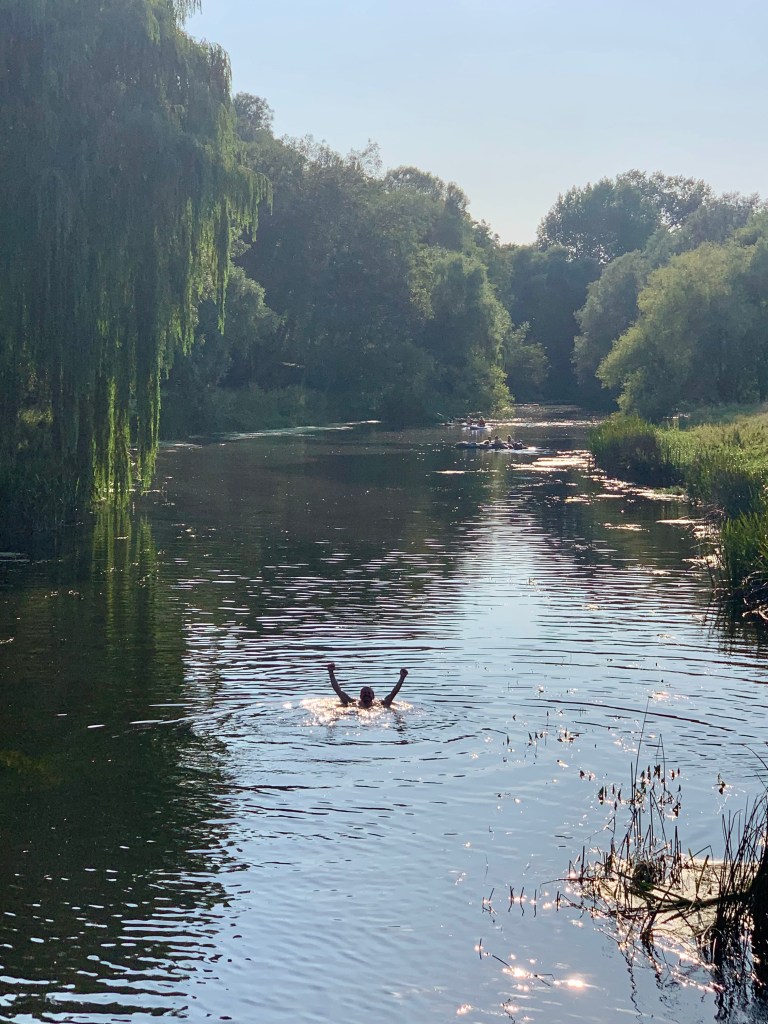
Peak England
In time (I have no idea how long[3]), we reached an abrupt stop. An unnatural tarmac-ed area; a dense patch of fir, sick with monoculture and encased in Heras fencing. Shaded and cold, it put a jarring halt to the phantasmagoria. We were highly sensitive to this spell-breaking change, like the lights going on in a disco halfway through the slow dance.
“It’s the shit bit”, declared Pete after a troubling silence. “Everywhere has a shit bit; even the best places must have a shit bit”. We laughed at the unexpected depth of his observation as we hurried along the asphalt perineum, away from the shit bit.
Panajachel is Lake Atitlán’s shit bit. One of the few towns in the area, and indeed one of the very few with a road connecting it to the outside world. It sits awkwardly on the north east corner of the lake, choked with traffic, and covered in markets and shops selling homogenous tat. Adjacent to the harbour, various substances of dubious provenance ooze into the lake. ‘I must get away from here’, is my first thought.
I book myself into a place called La Laguna in one of the waterside villages, Santa Cruz, the following day. In the meantime, to ensure maximum time away from the shit bit, I rent a motorbike. I can’t legally ride a motorbike, but I can ride a motorbike, so I make up some rubbish to the rental company about UK licenses being re-issued. They don’t seem to care and happily hand over a 250cc bike and off I go.

Getting a selfie on a motorbike is as challenging as it sounds.
In one final bus-related twist, by far my biggest concern as I ride around the lake for the day is the Chicken Buses. These are old American school buses that have been stripped out, re-sprayed with an individual paint job and gloriously tuned up[4], to act like a kind of ‘high’-speed infrastructure network. A latter-day version of Ken Kesey’s Merry Pranksters, each with its own Neal Cassady conductor, playing loud music and swinging aggressively to the cadence of the ride. The pace these things can reach is astonishing, and they keep me on the edge of my narrow seat as they fly past in a blur of bright colours and Doppler-effected psychedelic rock.
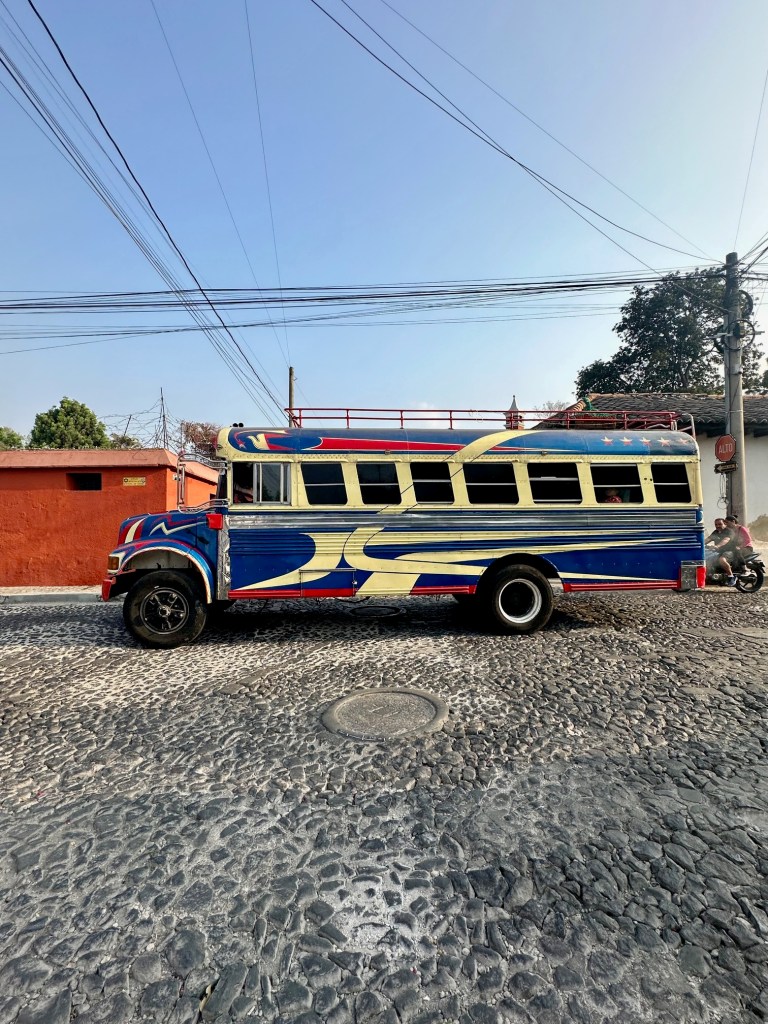
A rare picture of a Chicken Bus in repose.
I love that things like this exist. Despite all socioeconomic winds directly against them. Someone had a mad creative vision and made it happen. And despite their disregard for my road position, I’m glad for it.
Working the sequential gearbox with my left foot as I speed through village after village, avoiding abruptly turning farm vehicles and being chased by Chicken Buses, I am delighted to be tip-toeing my own caldera of self-preservation.
The next morning, I hand the bike back and jump on a boat to La Laguna, a hotel-come-hostel on the waterfront only a few bays west of the shit bit. I immediately relax upon arrival–this is a good place, with positive energy, and fun, easy-going souls.
On a whim, I decide to take my AIDA1–an introduction to freediving–whilst staying here. Freediving has not been on my agenda, and (thankfully as it turns out) I’ve never seen The Deepest Breathe, but I do have a somewhat morbid fascination with how far I can push my body. The very basic principle is to ‘duck-dive’ and swim directly downwards, following a line of rope, until you feel you don’t have enough breath to continue, but do have enough to get back to the surface. It’s a game of chicken with yourself. The major difficulty is not just holding your breath[5], but equalising the pressure as you dive. The easiest way to do this is via the Valsalva manoeuvre[6], as you instinctively would on an aircraft; however, doing this intermittently, whilst holding your breath and diving down, is challenging. Across three days, I make it down to 14m, which is pretty good for a beginner, but to put it into context, the world record is currently 133m[7]. I’m told there is a tranquillity in the long breath holds, but I’m not there yet.
I get to know some of the staff at La Laguna–almost all on temporary stops along their travels–and settle into a morning routine of sharing a large pot of coffee over a couple of hours of idle chit-chat. One person, in particular, captures my attention. She worked on the Biden campaign and then in finance, and like me is considering a career shift. On my final morning, she encourages me to stay another night and join in the dress-up BBQ (danger: I have a history of fairly committed cross-dressing that may or may not be a good thing to reveal here). Not today though. There is a boat leaving later that morning and I quit while I’m winning and hop on it. ‘Our conversation was good for the soul’, she says as I leave. Was there a lingering glance? A compelling woman.
Back in Antigua
Until this point of the trip, I’d done well to avoid any kind of injury or illness. Perhaps it was an ear infection from the diving, perhaps it was just raw sewage on the lake in Panajachel. Either way, as soon as I’m back in Antigua, I feel myself starting to descend. It culminates in two days in bed in a hot room: delirious, sweating, drifting in and out of sleep. After a bad 48 hours, I drag myself outside and find myself in the middle of the Semana de Santa festival.
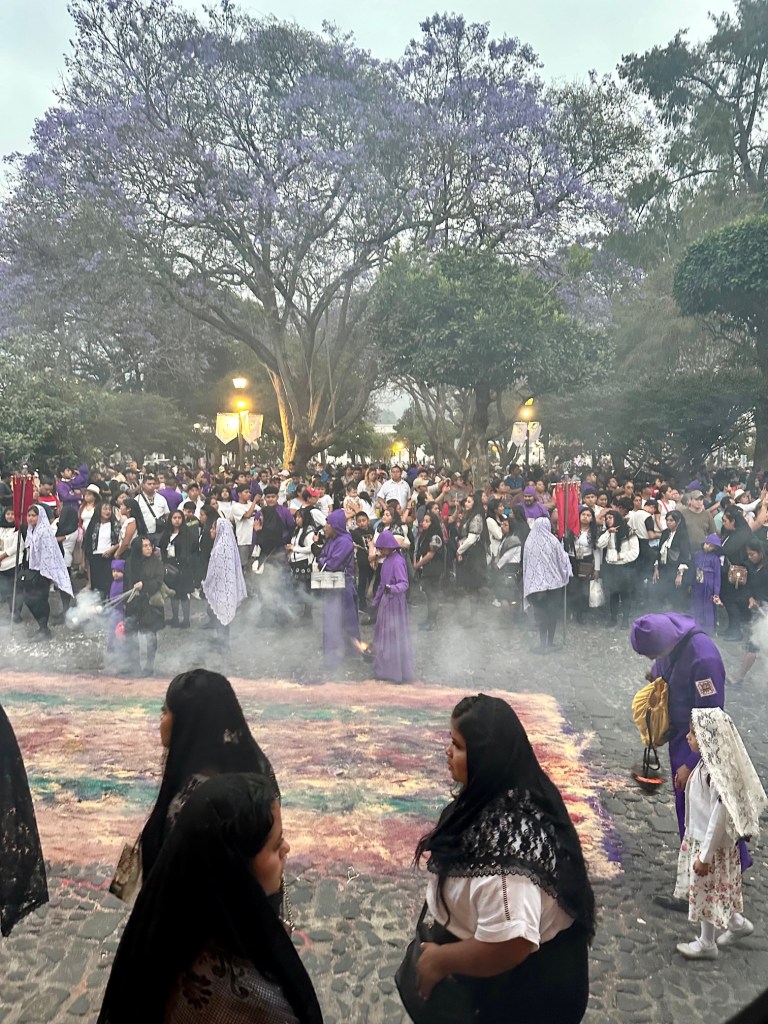
Wandering, delerious, into a Dan Brown novel.
I am not a religious person, as I think I’ve made fairly clear, but I can find other people’s religious commitment and self-sacrifice, especially with regards to the uniting of community that it can bring about[8], to be moving. I discover that watching the festival in my cold sweat-soaked delirium, coughing on the copal smoke billowing into my face, to be an emotional experience. I can’t, however, shake the thought that they’ve done a brand sponsorship deal with Cadbury’s. It is Easter.
Coffee
I started drinking coffee with regularity, in Café Nero, Guildford, c. 2000. Our school afforded us the luxury of lunches out in town, so for most of the Sixth Form, I was to be found here, with the smokers, drinking as many black coffees as I could across the course of an hour.
My interest in speciality coffee came much later and was a response to a girlfriend, who had a habit of needing coffee to get out of bed. As a naturally early riser, this was bizarre to me, but I soon realised that if I made it for her, we could quickly get up and get on with our day at a more appropriate hour. Crashing about in her kitchen at 6 am, I soon improved the setup and was drawn to ever more complex flavours, and usually had a couple myself before I’d even stirred her.
Fast forward to 2024 and it’s now something of an obsession, and I subconsciously distribute coffee and coffee-making equipment in the places I stay regularly[9]. I am aware that talking about coffee to those not interested in it can be exceptionally dull, so I will deliberately avoid talking about processes, washing techniques, roasting temperatures, etc[10].
There is good reason it has settled down as a natural bedfellow to hipster life, but I think many people are missing out on a far greater experience, in part perhaps, because of that. Snobbery thrives in the aspirational world of fine wines and high-end restaurants–the average Brit would be horrified to publicity reveal their inability to decern their Claret from their Beaujolais (deliberate Blur reference)–but the inverse is true of coffee. A peculiar reverse snobbery purveys in the general public’s attitude. As if Nescafe or Starbucks in some way represent the common man.
Not many of us are the common man in England anymore–not in the way that can compare to coffee producers in Guatemala. In the Western World, we enjoy the soil, labour and logistically intensive produce of global supply chains at the touch of a shiny ‘N’ button, or the flash of a smartphone for a pint of iced latte. We’re immune to the true cost of most of the products we consume, and this of course goes far beyond coffee.

It took me over an hour to fill one basket. I would not find employment here.
I was introduced to De La Gente through my coach (yes I have a coach) in the US. They are a not-for-profit organisation that supports, markets and distributes Guatemalan coffee. Setting up cooperatives, they guarantee prices for farmers’ produce ahead of the season, taking on the market risk themselves, and they bridge this gap through coffee tourism with people like me.
I spend a week staying on Manuel Gómez’s farm, hosted by him, his wife, Rosie, his family, and Ronald from De La Gente. The overwhelming feeling I get from this week is the happiness and joie de vivre that Manuel and Rosie project. But I am under no illusion as to the work that goes into this–during harvest (December to April), they are up and working dawn to dusk, seven days a week.
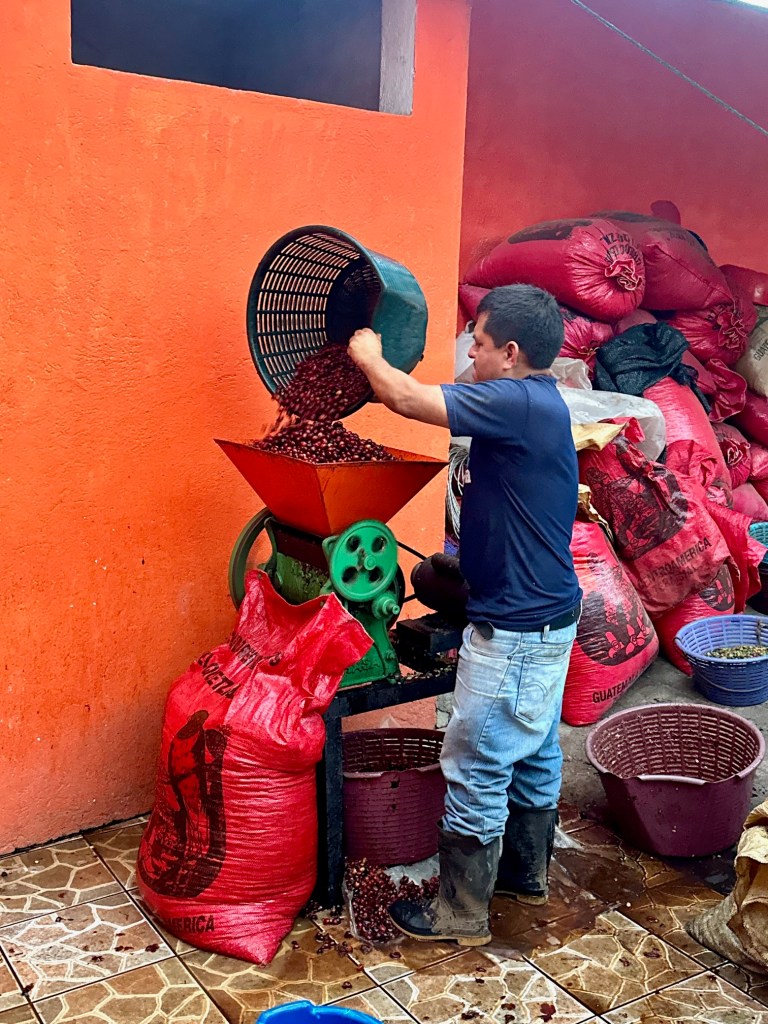
Hard graft with little mechanical help.
One of the things that sets this style of production apart is the care for the environment in which the plant is grown. Ronald is at pains to point out that other species of trees and plants, and animals–even those that would be considered pests–are allowed. “We are in their home growing coffee, not the other way around”. “Even the Chanate?”, I ask on the way home from the fields one afternoon (the Chanate is a bird that likes to pick coffee beans off the bushes for no other reason than it finds it good fun). Ronald furrows his brow and looks at me directly “That guy” he says earnestly, “is a sneaky bastard”, before breaking into a wide grin. Manuel cackles wildly from the front of the Hilux. Even the Chanate gets away with it.

A bountiful harvest in 2024.
Manuel’s coffee is some of the very best in the region and he and Ronald ensure that any space in my bag is tightly packed with various types of beans that we have worked on together. A magical and deeply connected experience that has changed my perspective on coffee and highlighted to me the importance of being a conscious consumer. I know how much work goes into this now, and it’s expensive because it should be.
On my final day in Antigua, I take a Chicken Bus out of town for a change of scene. Sitting there watching the fields fly past the volcanic backdrop, I can’t help but wonder if at some point in the past one of my American friends sat on this seat on their way to school, decades ago on another continent, full of their dreams for the future, or perhaps more likely, in the midst of a scrap. I decide that the chances are infinitesimally small, but that there is a chance. And that is a comforting and grounding thought.
Random thought generator
Whilst I was lying in bed in Antigua, sick and lamenting the ineffectiveness of the ceiling fan above me, I scribbled down a fair bit of nonsense. I have binned most of it, but I did think this worth sharing.
‘The search for meaning gives us reason to move forward in the face of the rational conclusion that nothing really matters. The hamster wheel of life! Life is an iterative calculation of meaning. A circular reference we must get comfortable with.’
[1] An American friend recently asked me if I was posh. I said, ‘that’s a very difficult question and requires a complicated answer’. I threw the question to someone else, who replied with ‘a lot of Brits would think you’re posh, but to proper posh people, you’re not’. A fair assessment.
[2] I was born here, so I can say this.
[3] The linear track of time starts to unpick, and fast forward, rewind, and sometimes even go up and down (that’s new). Don’t, however, start a conversation about the relativity of time.
[4] Some sound like they have been via Newport Pagnell or Maranello for their engine rebuilds.
[5] And at 1,500m oxygen levels are noticeably lower.
[6] Hold your nose and breathe out, which forces the air trapped in your head out of your ears.
[8] Of course, the opposite can be true, which you will know about if you’ve ever watched an Old Firm derby, or, taken a passing interest in Irish history since the invention of the news.
[9] Pete pointed this out to me when I gave him a Chemex ‘to say thanks for having me’ last year. Someone I was dating in New York appeared to do the same thing when I gave ‘her’ some beans and better coffee storage.
[10] I uploaded a series of stories to Instagram to show this pictorially, so if you missed it and are interested I’ll send you the video.
 Another Door In the Wall