10th – 17th of February
Cuzco
The so-called navel of the world[1]. It’s also – initially – a welcome contrast from the oppressive humidity of the jungle. The air is thin and bone-dry, and I’m consciously searching for more oxygen with each breath as we disembark the flight from Lima.
I feel fine at first, but Jenna quite spectacularly is not – she looks like she’s seen several exes lined up in arrivals to greet her. Over the next couple of hours, though, I get steadily worse, until I’ve accepted a status quo akin to how I feel just after a marathon. Waking the following morning is reminiscent of getting up on day two of a stag. Don’t drink here, it’s not worth the pain[2].
A World UNESCO Heritage City – and the historical capital of Peru – the old town of Cuzco is an impressive citadel. Fortified with thick walls of expertly cut diorite, the streets and buildings present an old-world feeling; the soft,verdant mountainsides that surround it frame its antique charm. There’s virtually nothing left of the Incan city that pre-dated its 16th-century conquest[3], which explains its European feel – ignore your shortness of breath and this could be a large Bastide town in the Dordogne, or a small Andalucian city.
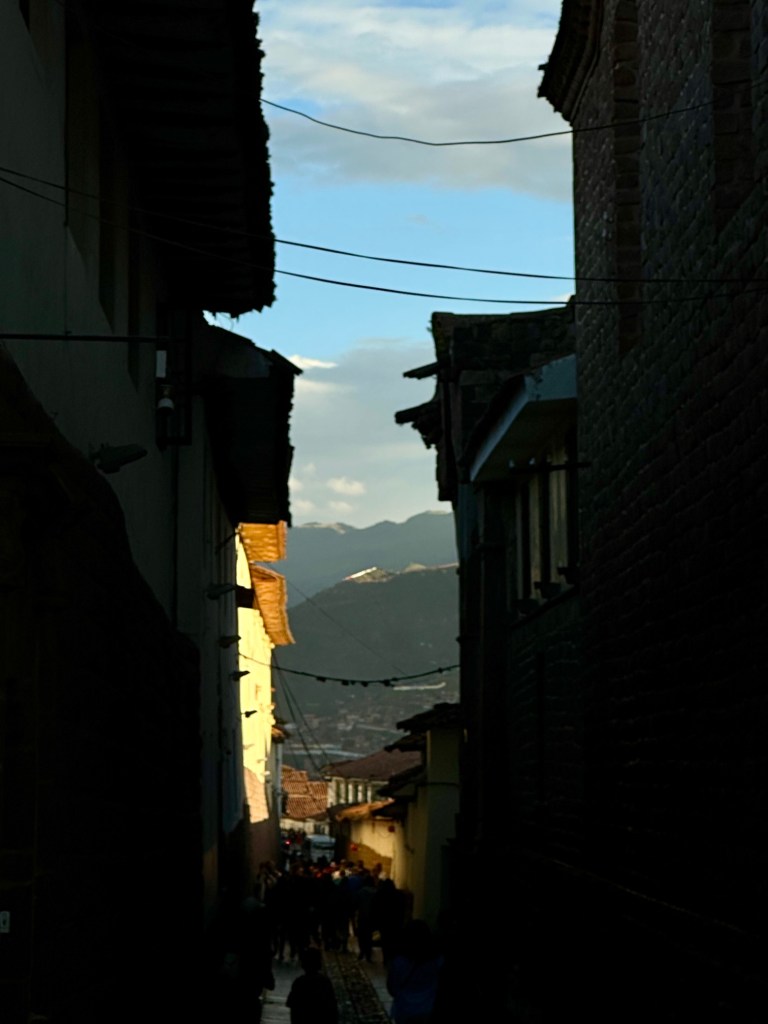
My first sense of Cuzco is a positive one. It has a high-octane energy, in spite of – or perhaps because of – its lack of oxygen. It’s a test just to exist here, and this sharpens your wit. The sun is notoriously strong, too, and all the locals take good care to avoid it. Not the Englishman, though (obviously).
Following my education of the indigenous cultures of the jungle, I’m delighted to spend some time in the Museo de Arte Precolombino. I would attempt to sum up my feelings here, but a quote from Kandinsky on the wall does it far more eloquently than I could.
‘Our sympathy and our spiritual relationship lie with the primitives, because like us these artists seek to express in their work only inner truths, renouncing, therefore, all that is distracting in surrounding form.’
Wassily Kandinsky
After a month on the road, a lot of what has been distracting me from inner truths – truths that I have been masterfully obfuscating from myself – are perceptibly lifting. It’s also a reminder to me of our primal need to create art; to create unencumbered by expectation. One of our greatest fears, and subsequently obstacles, often turns out to be our mediocrity – that however hard we try at something we’ll only ever be average. Easier to say you ‘could have done it if you had tried’, or ‘had the time’. And this is a pity because strip this fear away and I think a lot of us – a lot of you – would spend leisure time drawing and painting, sculpting, singing, dancing, or playing an instrument. Do it, even if you’re not very good at it. Virtually all of us will only ever be average at everything, and it doesn’t matter. Be prepared to be average at it for the rest of your life, but if you enjoy it that is all that matters. I guarantee you will feel more fulfilled and connected – and sleep better – than if you bang Netflix on at the end of the day.
And on that note, another symptom of altitude sickness is poor sleep. After three nights in Cuzco, I’ve barely slept at all. When I do manage to drift off, I’m straight into high-stress dreams – bad-tempered board meetings; turning up to A-Levels and University finals without having done any revision (not too far off reality). Each time, I’m jolted awake by a particularly difficult question. And I’m gasping for breath. Time to find a way down the mountain.
The Sacred Valley and Machu Picchu
Coming into this leg of the journey, I was liaise-faire about visiting Machu Picchu. I know that’s reasonably controversial, but it’s never called to me, and I strongly suspected a case of the emperor’s new clothes. But after a voice note from my old friend, Pete (who was running around this place in 2003 surviving on a diet of coca leaves and lager), I conclude that I should go. ‘Well mate, you’re already in Peru, and it is – you know – one of the Wonders of the World. You should probably think about visiting.’ [You fucking philistine (his intonation seems to imply)]. Plus, it’s almost 1,000 metres lower, which really is the deciding factor.
The routes from Cuzco to Machu Picchu are numerous, varied and encased in a heavily unionised public transport system that makes taking a train in England feel comparatively Japanese. I’m almost not allowed onto a connecting train because whilst I have a ticket, it hasn’t been validated (a process which involves standing in a secondary queue to have an official look at your passport and issue you with… another ticket). It has been suggested to me that if you can manage to get past the Vogon attitude to process, the panoramic train is the best way to enjoy the trip.
Of course, it turns out that this train involves a bus – a two-hour one – out of Cuzco. It’s here that you see the modern Cuzco – the one where most of the locals live. It’s not quite a shanty town, but it’s not far off, and I feel a sense of guilt that my assessment of the city really only covers half of the story.
When we finally reach it, the train itself is a delight – two narrow gauge mountain locomotives[4] work the winding journey through the gorge adjacent to the Urubamba River, which has cut this route for millennia. The panoramic carriages add a glorious sense of scale via the vertiginous backdrop. Perhaps to justify the price hike from the cheap seats at the back, there is also a little show we’re encouraged to go and watch in the adjoining compartment. I’m not a fan of this kind of tourism[5], so I sit stoically on my own writing this blog. The added light is a right bugger on the screen, incidentally.
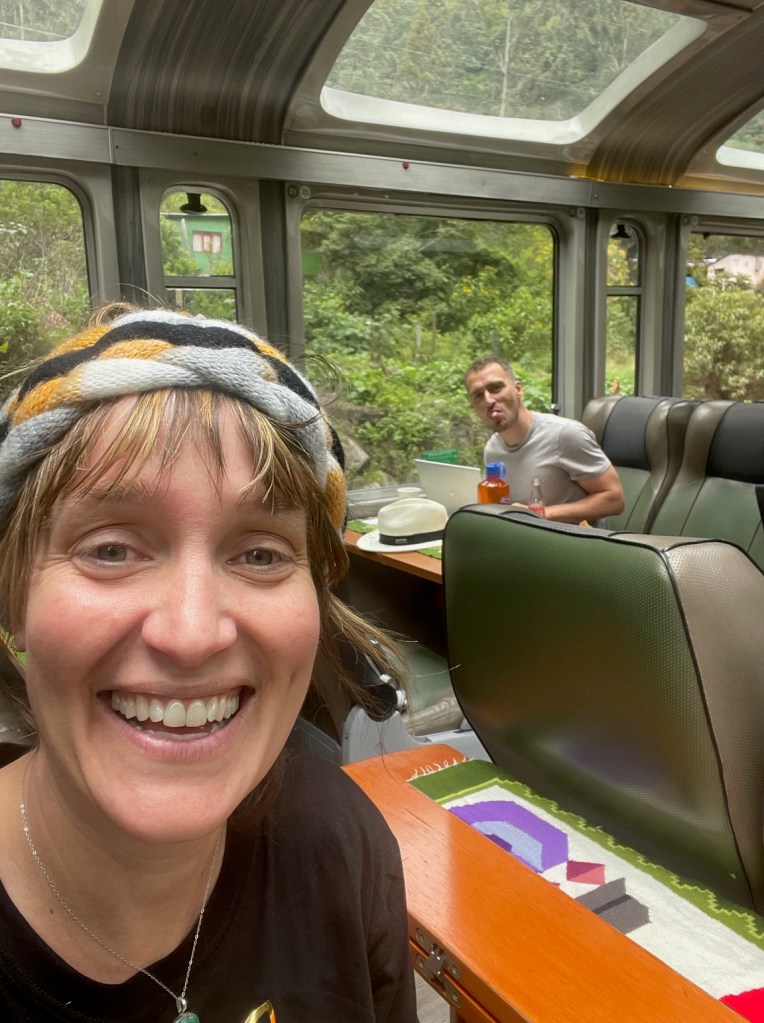
Please, leave me alone to be Stoic (grumpy).
The town itself – at the base of the mountain from Machu Picchu – is called Aguas Calientes. Unless you undertake the four-day trek, this is your only starting point to get up to the ruins. I strongly recommend that if you ever make it to Machu Picchu, one night is the maximum you want to spend in this town. Even the owner of the hotel can’t believe we’ve booked three nights, which is swiftly reduced to two.
Our ticket (booked, stamped, validated, and resubmitted in triplicate for final approval) to Machu Picchu is the following morning. Slots are timed and it’s only a short bus ride away…
It’s an early start. And on final arrival, the conditions are… Dense cloud. There is a vast group, variously covered in plastic ponchos, sitting silently in position for the photograph – visibly stunned at the situation. Many of them stare in disbelief at their guide; some, it seems, almost close to asking the question – ‘what are you going to do about it?’ It probably doesn’t reflect well on my character that I find this utterly hilarious. I love photography, but I guarantee a better one has been taken of this view; and isn’t this a great reminder that we, for all of our goals in life, are not in control?

One of my favourite photographs of the whole trip
Jenna and I take a seat on a wall and watch the clouds drift through, forming our own assessments. ‘It’s quite modest’. ‘I thought it would be bigger… Is there more?’ ‘Give them their due, though, it’s not a bad effort… Not really, though, all these stones were here! The creators of Stonehenge had to roll them from Wales to Wiltshire, thousands of years before they built this!’ I conclude, jingoistically. As if my random emergence in this world in the South East of England in the mid-1980s somehow gives me a sense of affiliation with pre-Roman Britons, whose lives we know virtually nothing about. It’s a strange contagion, nationhood.
Driven by a shared sense of disappointment, we find our way onto a trail to climb the adjacent mountain Huayna Picchu. There is, however, an official guarding the way asking to see yet another type of ticket. Jenna explains the situation, I find some dollars in my bag and the ticket miraculously transforms. Where there is bureaucracy, there is bribery.
Crime pays, and Huayna Picchu saves the day. A two-hour hike there and back via steep stone steps, taking in an ancient temple and an incredible view down on the valley – and the ruins. The physical challenge also keeps the crowds away.
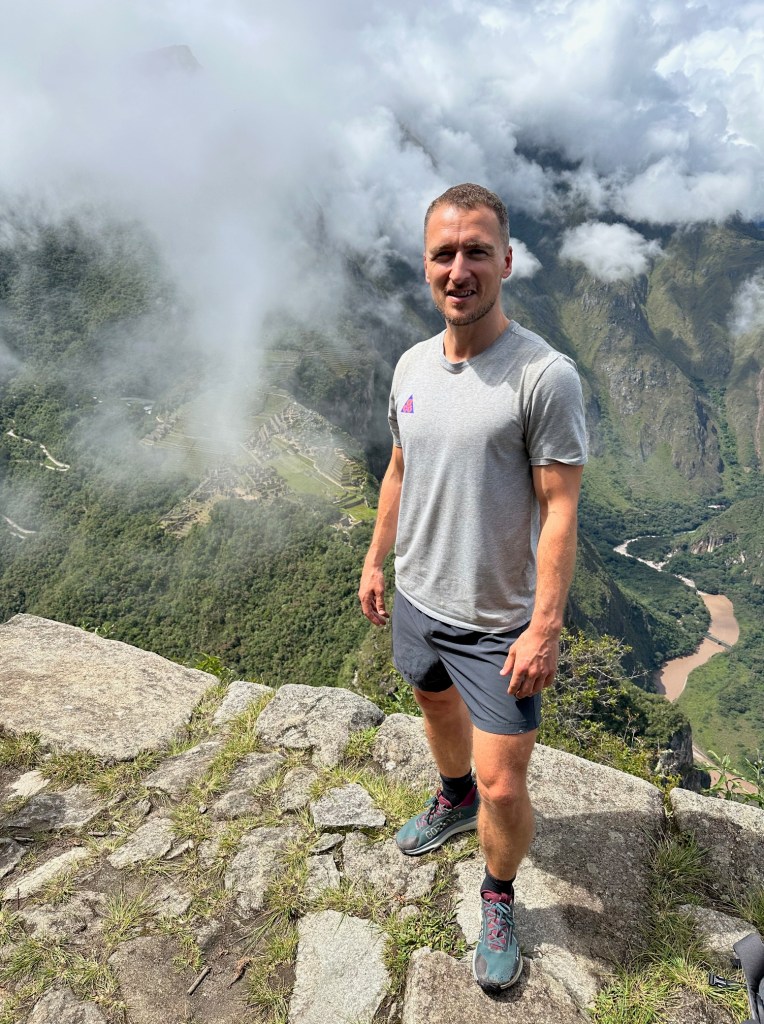
It was OK
I’m not a Bucket List sort of person, and I don’t feel the need to say I’ve been anywhere (present blog accepted), and I suppose one day I’ll be glad I saw it, but my ultimate feeling on leaving Machu Picchu is that I would have to love someone very much to come back here.
A brief but memorable return to Cuzco
Escaping Agues Calientes means we’re back in Cuzco sooner than planned, and my issues with the altitude have got no better.
The most prevalent, but least socially acceptable symptom of my altitude sickness is stomach trouble. Add in all the cereals, the ceviche, and the raw onions, and you have a sense of uncertainty and anxiety one could really do without in a foreign land. It’s hardly Delhi Belly, but in a way, it’s worse. It’s random. You can’t fart with any confidence. And like a game of Russian Roulette, it’s inevitable that eventually, you’re going to reach a sticky end.
The final symptom of my mild hypoxia is by far the most interesting, and I’m going to struggle to articulate this, but I will give it a go (I promise you no hallucinogenic drugs were consumed ahead of this experience). On the first night back in Cuzco I must have awoken in the early hours. The abstract absurdity of existence is vividly playing through the virtual reality generator that is my mind, but it is inverted. I am outside, observing Istigkeit – isness. I’m watching – and, crucially, feeling – not my consciousness, but consciousness itself. I have no idea how long it lasts, but eventually, I return to the driving perspective and start to laugh.

Even the sculptures are struggling in this environment
Almost fifty percent of Peruvians identify as one of the 51 indigenous peoples across the country – one of the highest proportions in the world. As someone from England, this is mind-blowing[6]. Anyway, its carnival season in Peru, and my final day in Cuzco coincides with indigenous groups from the surrounding region arriving in their unique dress to dance the ancient dances of their people through the streets of this enchanting city.
The late, incomparable, AA Gill, wrote a brilliant (and strangely moving) article about the Morris Men of England[7]. Morris Dancing is England’s only folk dance, but it is a restoration; something older than we can remember, something that – choked by the Industrial Revolution – we lost touch with. And so, what plays out in the cranky towns and villages of middle England today, is a hopeful reenactment[8]. I can’t help but consider what I see in front of me through this lens – but crucially, this isn’t a restoration, this is a continuation. These curious – in some cases, quite literally antediluvian – signature movements of human beings, gliding past me, are far older than the ruins I was in two days ago. Older, even than most countries. Isn’t that wonderful?
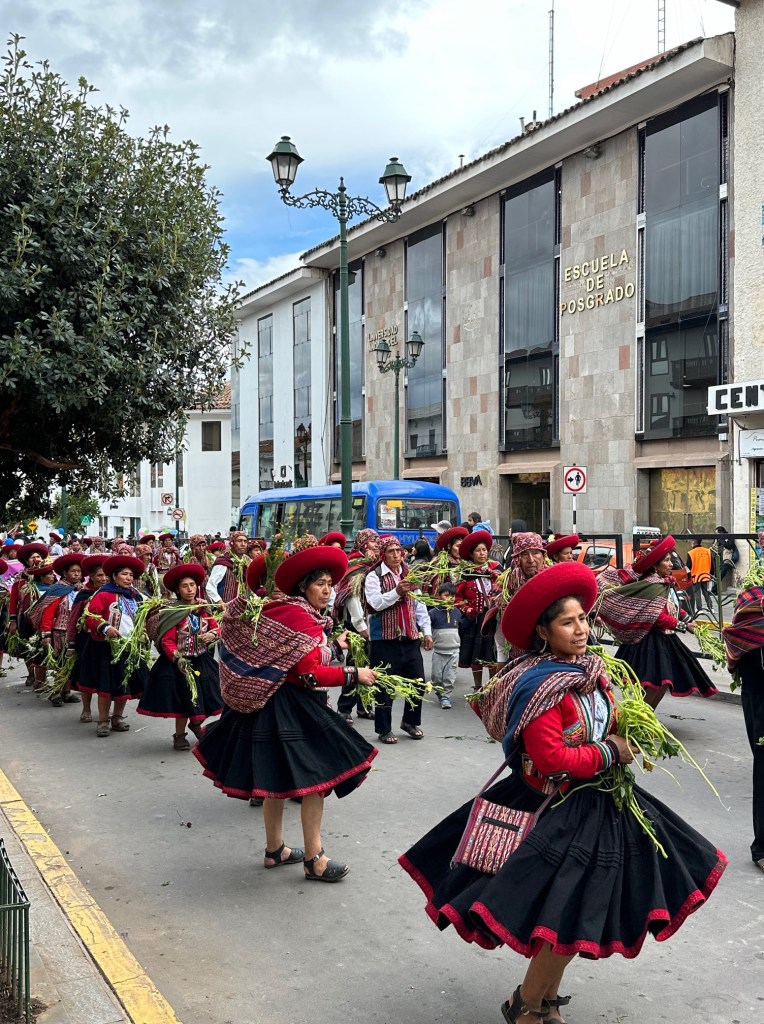
A group stomps past me, draped in a diverse selection of vegetables. At the centre, one chap is carrying what appears to be a sapling he’s chopped down from the side of the road – it’s slung uncomfortably over his shoulder. The obvious messianic metaphor is puzzling for a tribe so overtly connected to the earth. But perhaps it’s older than that? I’m overthinking this. He turned up late this morning because he was pissed last night, forgot his grass garland and genuinely did saw a tree down in the bus station car park. My mind wanders… The poor bloke only went out for a few drinks and is now in danger of accidentally starting a new religion. Let’s not forget: less believable stories have had global success.
In the evening, Jenna and I decide to eat the magic mushrooms she bought in the jungle (as if my previous night’s episode wasn’t enough). After a couple of enjoyable hours building and maintaining a fire in our Airbnb, and listening to Captain Beefheart, it becomes clear that these are duds. Percy sold us queer giraffes. And I enjoy a palpable sense of vindication at my original assessment of the archetypal chancer. I’ve had enough transcendent experiences this week.
The next morning, I start a two-day journey to the surf town of Nosara, Costa Rica. But Jenna is staying in the mountains. We say our goodbyes – it’s been a privilege to share this part of the journey with her, and she’s shown me the importance of engaging more openly with those around me. And a moving chapter – one far deeper and meaningful than our dissolute lives in New York half a decade ago – to add to our friendship.
For now, though, I need an extended period on my own with a surfboard.
[1] Spoiler alert: the only thing relating to my stomach of any note in this post will be the upset caused by the altitude. It’s 3,300 metres above sea level here, which does strange things to you.
[2] Some of my closest friends visited this city twenty years ago (when I was busy skiing in Chamonix). They returned with stories of quite the party town – didn’t get any sleep for 48 hours etc. It must be an age thing because I don’t see any of this.
[3] The Spanish raised all but the old temple, upon which they built their own Catholic church. I take a short walk around this gaudy manifestation of fear and shame, practise my handstand in a secluded vestibule, and leave.
[4] I was in the model railway society at school – the proud owner of a Type 37 in Mainline Freight livery, and a Diesel Shunter (my favourite), which created more chaos than it ordered in the goods yards of the RGS. In my second year, I was thrown out of the society for recreating a major accident at a level crossing. [Grammarly wanted me to remove what it saw as a superfluous ‘the’ in the preceding sentence. I understand its perspective.]
[5] Locals putting on traditional dress for the entertainment of the Western traveller. It feels uncomfortably like I’ve strayed into a theme park. Isn’t the train, the geology, the architecture, enough? Why do we have to Disneyfy these experiences?
[6] I don’t think Geordie counts as indigenous, for example.
[7] If you’re a UK Times subscriber, I encourage you to read this. If not, come over to my flat in Hackney when I get home and you can borrow the book.
[8] As a result, England’s risible interpretation of this odd pastime is entirely acceptable. It’s an imitation, and that’s a crucial point, it would seem, when assessing the appropriateness of prejudice.
 Another Door In the Wall