10th -13th of January, 2024
Surprisingly, it’s only a three-hour time difference from London. So, despite a long overnight flight, I feel remarkably fresh on arrival. The other thing worth remarking on is the heat and humidity, it’s 30 degrees and sticky.
There’s something odd about leaving the depths of an English winter to arrive directly into someone else’s summer. And especially so with no discernible jet-lag to explain the shift. It feels almost like I’m cheating – like I should really be enduring the winter to deserve my time in the sun. Those fucking Victorians again.
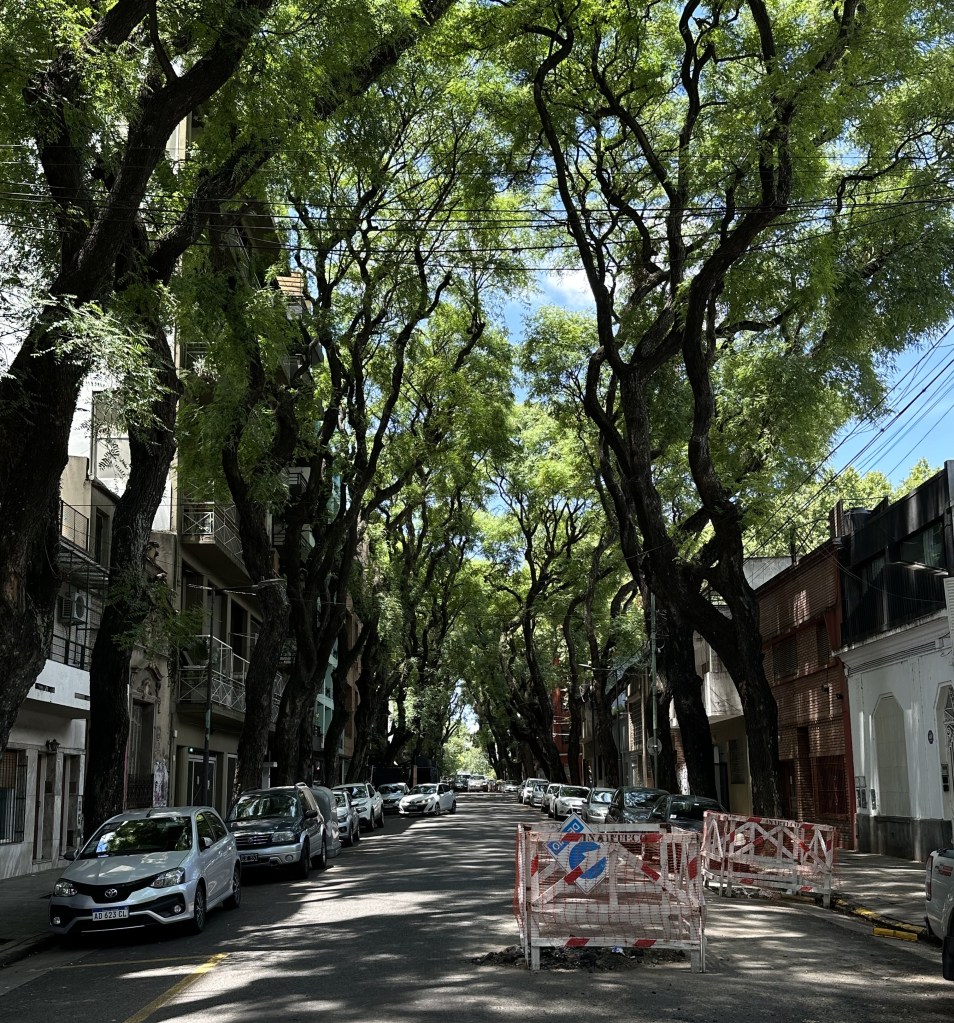
Following the usual walk around the local neighbourhood to get my bearings, I settle at a bar, under a voluminous lime tree at a cobbled crossroads, to watch the world. I’m staying in Palermo in the North of the city. It’s reminiscent of Roma Sud in Mexico City: a pastiche of low rise, colonial, half-finished, modern, I’m-not-quite-sure-what… Just about held together aesthetically by the majesty of nature. Some streets enjoy a full canopy of mature trees, but almost all possess an impressive array of arboreal decorations. And great coffee shops too. It’s the hipster side of town and I immediately feel like I’m in the right place. Speed of service is conspicuously pedestrian, but it’s a good reminder that time is not in short supply for me on this trip.
At the suggestion of a friend, I have brought Marcus Aurelius’ Meditations with me as a companion for the journey – the philosopher-emperor’s personal musings on the pains of life. And so far, it would seem: an fixation with our efforts in the face of the inevitability of death. Marcus was a Stoic, a philosophy I can mostly get on board with, but perhaps a dose of Epicurean joie de vivre wouldn’t go a miss to keep the spirits up.
Whilst I was contemplating this, the sky darkened, and the rain started. As storms go, it was a memorable one. The thunder rumbled away civilly in the distance, never really troubling the locale, and the occasional lightning flash added just the right amount of drama, without shaking me up. But the rain. Fuck me, the rain. It really went for it – I’ve never smelt petrichor like it. The steaming cobbles and hastily upturned boozing barrels rebounded the water with vengeance, sending punters and publicans every which way. I was sat snugly – and smugly – directly under my tree, perched on a stool, nursing my one beer quota like a tramp lovingly cradling his first Special Brew of the morning. Other than the odd ricochet, I was entirely protected from the melee I was so perfectly placed to observe.
It was a privilege. The ideal way to get into the spirit of it. How better to be in place than be assaulted by the climate, hours after arriving. An alien watching the natives vulnerable from the outset. Their futile plans in soaking-wet tatters. How Stoic.
Over the next three days, I explored the city – mostly on foot. It’s a vast place and a relatively poor one too, so I had been advised which areas to steer well clear of. It wasn’t always this way though. Until the 1930s, Argentina was one of the richest countries in the world. And the faded reputation is mostly in evidence in the newer North of the city; built in this era of economic pre-dominance – new-found wealth to cover the cost of the space and grandeur. Like all Nuevs they loved a big driveway – the boulevards are massive. In 1871, with the plague in town, this crowd had left behind the cute but cramped houses of San Telmo (home of the Tango, in which I did not partake) in the South, to create this Northern salubriousness. These streets could have been overseen by Haussmann, and if it wasn’t for the shabbiness and ubiquitous Spanish, you could almost (almost) mistake it for Paris.

On the South side of the city is the Boca; the rudimentary port housing thrown up shanty-style in the 1930s to house millions of refugees (mostly Italian[1] and Spanish) fleeing war-raved Europe. This is the home of Boca Juniors – one half of one of the biggest rivalries in sport – the Superclasico. On one side, the posh Northerners, represented by River Plate; and on the other, Boca, the club of the immigrant working class, and most importantly of Maradona.
Behind the kitsch of the Messi mannequins (he’s middle class and from Rosario, a city inland, and perhaps part of the problem with a curious relationship the country seems to have with the little genius) and saccharine paint jobs[2], I find this area deeply moving. Just about in living memory, entire towns and villages were driven here by war and ethnic idealism, perhaps with the hope of a better life, perhaps just to escape death (I find multiple references to this social upheaval in museums and galleries across the city). On arrival, they would have found themselves wrapped up in a different sort of problem – a military dictatorship overseeing a countrywide socio-economic meltdown, on top of which, being shunned by the pre-existing Argentines. To be a ‘Cocoliche’ was to be one of these people. And Maradona was that. You had to fight your way through life, and as is so often the case in our suppressing class and caste structures, whatever you did, you were only ever going to be a Cocoliche.
Growing up in England, much like Argentina it would seem, means that you can’t help but know what’s going on in the football. I barely have a passing interest in it these days, but as a kid, I loved football. And I absorbed the stats with Rainman-like obsession. In this small world, you despised Argentina – playground rules meant you had to. And in particular, Maradona – his antics at the ‘86 World Cup, and of course the wider political context of that era – encapsulated the rivalry. I did, though, secretly love the pale blue and white stripes, and would often pretend to be Batistuta or Veron whilst belting a football at my poor sister (Happy Birthday, Clo), who I’d persuaded to go in goal, so I could practise my free kicks. Therefore, my surprise at a sense of connection with this stocky, bouffant-haired, renegade (should I be surprised?) was palpable and genuinely moving. Here was a man who seemed to find a way to unite a country’s conservative and classist generations through sheer brilliance on a football pitch and wild nationalistic passion. Seen through this context I finally understand the gamesmanship and cheating (it was blatant cheating). I almost bought a shirt (I didn’t).
Recoleta is the cemetery at the heart of the North of the city, where people are buried with pride and ecclesiastical purity. And here, my overriding thought – beyond the usual sense of solemnity one feels in a graveyard – was one of vulgarity. Don’t get me wrong, the architecture and sculpture are beautiful. But I’m hardly pushing a Bolshevik agenda to say that here is a country with huge economic issues[3], and yet so much money continues to be spent on an egotistical expression of death. There are people sleeping on the pavements outside the gates, whilst corpses are afforded greater care. It’s one of the reasons why I detest Abrahamic religions with such vehemence: they prey on people’s mortal fear, offering the promise of eternal salvation in exchange for a grovelling existence in the here and now. Marcus Aurelius would probably have considered the Christians an eccentric cult in AD180, imagine his disappointment and bewilderment if he’d known what was to come – among the utter breakdown of Western civilisation, the rejection of Stoic principles in place of lavishing and fetishising the dead at the expense of the living. To be clear, I’m not advocating an Imperial agenda either, but when can we all move on? It vexes me greatly that civilisations over two thousand years ago had a more mature, philosophical approach,[4] to the realities of life and death than we do today.
But I like Buenos Aires. It has a positive, youthful energy to it. And the people seem friendly, even if they were smiling and telling me to ‘fuck off’ in Spanish. If you’re a fan of steak, football, modern political history and the female bottom, this may well be the place for you.
An addendum
I regularly write notes to myself on my phone. Most of the time it’s nonsense, but occasionally something becomes the kernel of an idea. I thought it would be vaguely amusing to include these periodically as I pass through this trip. Here is what surfaced from my subconscious whilst I was in Buenos Aires.
- What role do we play now?
- What philosophical school would represent us best today? By extension, is this partly why modern politics doesn’t work for most of us born after 1980?
- We’ve lost our philosophy.
- Bring together Russell’s In Praise of Idleness, with humanist views of wilding, pagan traditions of dance, community etc. and a modern understanding of nutrition, sleep etc.? A belief system for a world crying out for the community and connection that religion used to give us.
- Buy a farm and go wild.
- Is it ok to piss in a bidet?
[1] I remember from 90s European football matches when teams were limited to three non-EU players per match, the Argentinians always seemed to be able to find an Italian Grandma from down the back of the sofa.
[2] It turns out the colourful houses are a result of having to use left-over boat paint for their homes. I should probably temper my cynicism.
[3] Current rate of inflation, 211 (two hundred and eleven) percent.
[4] Capital punishment, gladiatorial games and slavery aside…
 Another Door In the Wall