December 12th 2023, New York
Pre-amble
I was restless, so I took a trip to New York just before Christmas. A chance to reconnect with the city and with old friends. It had been a tough end to the year, and I sensed a pull to go back. Having lived in the city for two years between 2017 and 2019, I love returning. Our relationship is complicated, but a deep connection remains.
Having travelled across much of the US, the quality of its infrastructure (like its coffee) has always bewildered me. And I come from a country with a consistently broken Victorian rail network, and a new £100bn high-speed link being built from Birmingham to an outer London suburb where no one lives. So, with an hour to kill, and a loose plan to write a travel blog in the New Year, I thought I’d try and collect some thoughts together and have a bit of a moan.
For my American friends, in particular: it’s written with fondness as well as the obvious exasperation. Like most complicated relationships.
Here I am again. JFK at 6:30 AM, contemplatively staring out of the window into the dark. I won’t find anything meaningful here, though. The glaring strip lights of the oppressive, low-ceilinged lounge reflect directly into my maladjusted eyes – these awful a-temporal rooms with their pallid-skinned punters jostling for free booze and status. If it wasn’t for the perpetual disarray that ensues in American airports, I wouldn’t countenance these depressing, soul-draining spaces.
The US is comfortably the world’s richest country, and New York is the paragon of its unapologetic capitalism. The country’s collective wealth is mind-bending. Measured in pure numbers, it makes the various economies of Western Europe seem like anachronistic co-operatives. Yet, in this Libertarian world, so little of the wealth trickles down into public investment; and as a traveller in this land, this is rarely more obvious than when contemplating how one gets around. I had to take a taxi along packed, crumbling freeways to get here from Brooklyn, but when I land in London this evening, my journey from Heathrow to Hackney will be via world-class mass transit. And the UK is barely mid-table at this; go to France, Switzerland or Japan to get a sense of the possible.
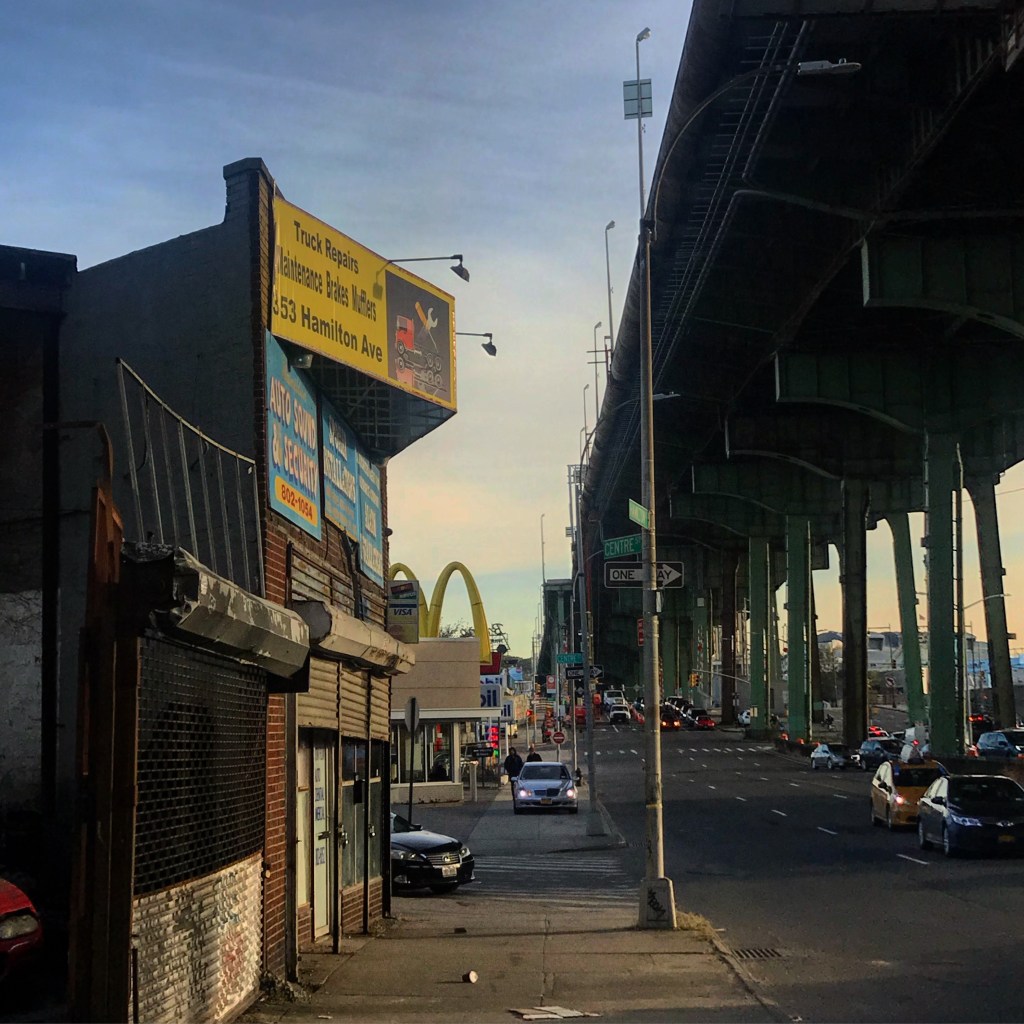
As a general rule, infrastructure in America is woeful. Bafflingly so when placed within the context of its wealth and history. This is a country with epic journeys at the heart of its storied provenance. And today, whether you’re watching the F train trundle over the Culver Viaduct in Carroll Gardens (which if you haven’t seen it, looks like a 7-year-old’s attempt at running a Lego train across a Meccano bridge); or bewildered tourists arriving at LAX trying to comprehend how they can even get out of the fucking building, let alone anywhere else, it is a significant – and curious – failure.
In 2021, President Biden signed a $1 trillion infrastructure bill designed to address this issue1. However, this is relative peanuts given the scale of the job. But why so parsimonious? Well, the country’s focus on personal – and corporate – wealth is an obvious factor. Big Government projects may be de rigueur in the Élysée or Beijing, but tax cuts that benefit business come first in the Land of the Free.
As the English philosopher Alfred North Whitehead argued “corporations kill the human spirit”, and most specifically with regard to craftsmanship and aesthetic appreciation. But I don’t think this explains the problem entirely. US businesses are preeminent in many creative industries: tech, design, advertising, etc., but unless you’re considering weapons or rockets (or most things that fly come to think about it), a lot of its engineering follows Whitehead’s view, and remains low-fi and barn door. To assist me in highlighting the point, the sun has risen in New York, saving my eyes from the fluorescent barrage. I can now make out the terminal laid out in front of me. The set-up is penitential. If you’ve ever seen the opening credits of The UK Office, you’ll know what I mean – mirror-glass-fronted, wilfully ugly buildings that reflect the sense of apathy that penned them. Utilitarian is often used as a euphemism when searching for a deeper explanation than “that’s awful”. But that’s what this is. The least amount of thought, beyond what is required, for the terminal to serve its purpose. This isn’t the greatest good for the greatest number, it’s the path of least resistance.
What is it about this blind spot for infrastructure? Until the emergence of electric vehicles (when tech took aim at the motor industry), you found this ubiquitously in their cars, too. No need for efficiency or excellence – just big, loud and fast in a straight line. Tell enough of the right stories about something and broadcast the message (they’re good at those bits), and within reason, people will crave anything. And so, the Chevrolet Camaro was a success. But a company like Porsche, for example, could never have emerged from America; it was too easy for it not to.
Does there need to be a change of philosophy if America is ever to build an infrastructure that befits – and buttresses – its status as the world’s greatest economy? How does government persuade corporations and individuals that it is in their long-term interest to give up some of their dollars today in pursuit of something that benefits the collective tomorrow?
Maybe it doesn’t need to. Maybe the fullest expression of capitalism just won’t allow for public investment on this scale, and fuck it, you’re all on your own. But consider how important journeys are to us, not just our destination or source. So analogous to our lives, the journey so often is the story. Consider the weight of literature and film that involve interactions at train stations, on spaceships or on boats – On The Road. We need inspiration from our journeys for our Journey – the romance of chance, fear of change and break from the monotony. It’s one of the few times we’re forced out of habitual routines, promoting novel thoughts; thoughts and subsequent perspectives that are vital to our personal growth – and by extension, cultural growth. And well-designed spaces and processes make us feel good; they soothe us and shake us from our somnambulance. A thoughtfully conceived arrival hall, or metropolitan subway that whisks you 20 miles across one of the world’s largest and oldest cities can genuinely inspire.
So, the socio-economic conditions may not allow for a world-class infrastructure network to ever exist here, but they can surely do so much better than this. And I would like to think that when it comes to re-building these airports, Interstates, subways, or even railways (best of luck with that), America will find a way to value the investment beyond the minimum functional requirements and bring some of their entrepreneurial spirit and creative excellence into solving the conundrum. Ignore the value of investing in the journey, and to outsiders like me, even the stories will start to lose their Kerouacian mystique.
[1] For context, Apple’s market cap is approx. $3 trillion (as at Dec 2023).
 Another Door In the Wall